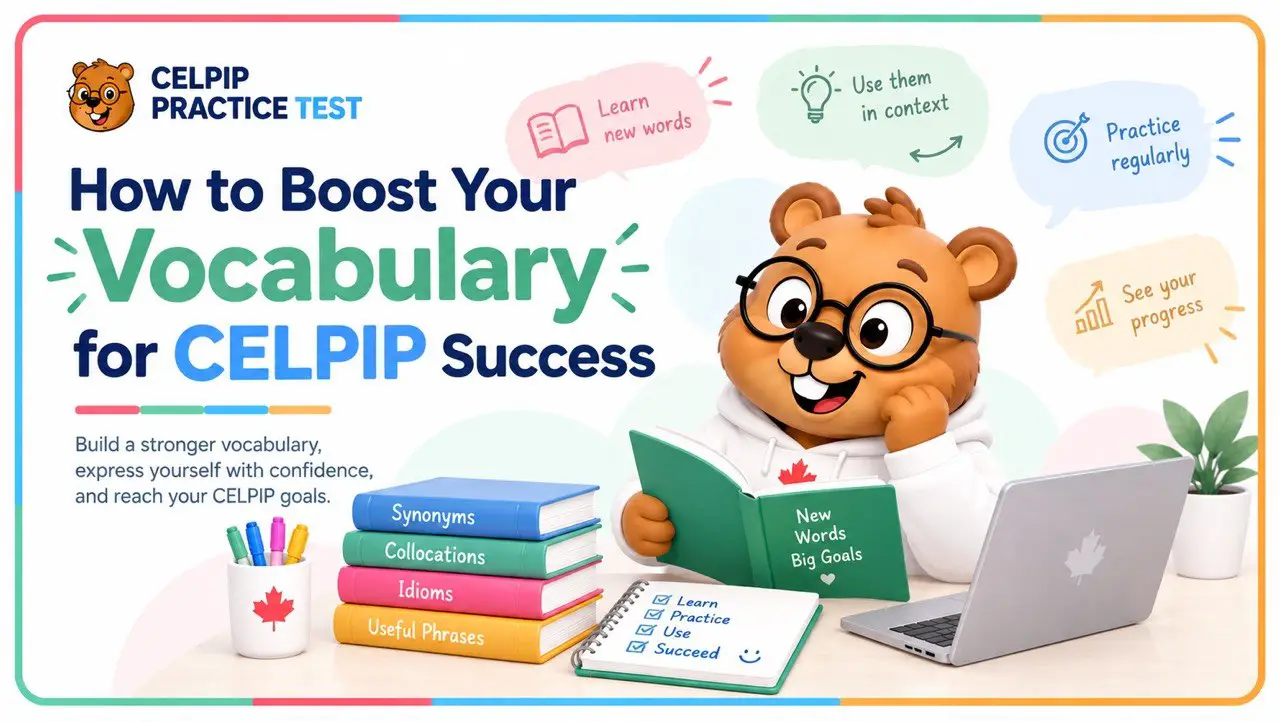
Your vocabulary can separate a good CELPIP test score from an outstanding one. CELPIP Vocabulary Mastery does not mean memorizing page after page of never-ending word lists; it means to learn words wisely and use them naturally.
This guide will teach you some practical ways to increase your CELPIP vocabulary, to combat common challenges to learning, and to develop your word bank to be one of your best tools for CELPIP test success.
The Importance of Vocabulary for CELPIP
Vocabulary is important in all 4 sections of the CELPIP test: Listening, Reading, Writing, and Speaking. Vocabulary is basic in how you understand the questions, answer them, express your ideas, and transfer the meaning.
A strong CELPIP Vocabulary will not only help you recognize more words but also allow you to use words correctly in context. The result will increase CELPIP Listening score. In Writing, varied/detailed word choices will demonstrate your skill at communicating meaning, ideas, or principles clearly and professionally.
Common Vocabulary Challenges for CELPIP Test-Takers
Having advanced levels of learners is still common when facing vocabulary, when preparing for the CELPIP. Here are some frequent difficulties.
Quickly Forgetting New Words
Many test takers study long word lists but do not remember many of them. This happens because they are learning words with no real context or repetition.
Using Repetitive or Simple Words
Often, learners use baseline words like “good” and “bad” or “nice” and “not nice.” The words are correct, but they do not demonstrate the advanced vocabulary expected of a CELPIP Test taker.
Therefore, at times, for example, replacing “good” with the words “beneficial,” “effective,” or “pleasant” will elevate your writing and speaking.
Confusing similar or Similar-Sounding Words or Phrases
CELPIP test takers will mix similar words like affect vs effect, advise vs advice, etc. Such minor mistakes can confuse the meaning of your sentence, as well as lower your score in Writing and Speaking.
Top 20 CELPIP Vocabulary Words for Writing
Here’s a practical list of high-impact celpip vocabulary words you should memorize:
beneficial → instead of "good"
problematic → instead of "bad"
therefore → instead of "so"
nonetheless → instead of "but"
consequently → instead of "then"
adequate → instead of "enough"
significant → instead of "big"
concerns → instead of "problems"
suggestions → instead of "ideas"
assistance → instead of "help"
feasible → instead of "possible"
efficient → instead of "fast"
unfortunately → instead of "badly"
Furthermore → to start a new point
Additionally → to add info
Therefore → to show reason
Moreover → to strengthen your point
Various → instead of "many"
Essential → instead of "important"
How to Use This Vocabulary in a Real Email
Here’s a sample email using celpip vocabulary:
Dear Mr. Lee,
I’m writing to request assistance with my housing application. The current deadline is problematic since I’m waiting for my employment letter. I believe extending the deadline by one week would be beneficial and feasible. Consequently, I’d greatly appreciate your support. Thank you for your understanding.
Notice how the word choices sound natural, professional, and avoid repetition. This is exactly what examiners look for in a vocabulary for celpip writing task.
Tested Methods to Broaden Your CELPIP Vocabulary
To improve your CELPIP vocabulary, you need to consider the following strategies.
Read diverse materials: news, blogs, emails, charts
One of the best things you can do to build your CELPIP vocabulary is to read as many authentic pieces of English material as you can. The CELPIP test assesses your ability in real life English use, which is obviously more than just textbook grammar, and definitely includes vocabulary from workplace emails, public notices, news articles, reports, and even social conversation. You can also practice this again through a CELPIP reading practice test.
Use Flashcards or Spacing Repetition Apps
Flashcards are an effective, classic workhorse for remembering vocabulary, and when combined with spaced repetition, a scientific learning concept, can help you remember vocabulary for the long term.
Instead of memorizing hundreds of vocabulary words in one setting, spaced repetition apps like Anki, Quizlet, or Memrise will ONLY show you a vocabulary word just before when you’re likely to forget it.
Learn Words Within Context, Not In Isolation
You could even take it further and practice using the word "appreciate" in your CELPIP speaking practice test or writing practice test, so you remember its meaning through use.
Concentrate on Academic and Common English Vocabulary
CELPIP examines both formal and casual English. This means that you need to know: Academic words like “analyze,” “evaluate,” or “summarize.” Common expressions like “run into someone” or “look forward to.” Having a diverse vocabulary means that you’ll be ready for the different types of questions.
Use Vocabulary in all CELPIP Skills and Practice
If you want to really learn CELPIP vocabulary, then you should be using it actively in all four (4) skills.
CELPIP Skill | Practice for Vocabulary and Terms | Example of Vocabulary Usage | Inhabiting Tip / Resource |
Listening | Engage in listening in a podcast, YouTube video, or CELPIP audio clips. Identify words that you do not know and write down the words that you overheard. | The speaker emphasized the importance of collaboration.” → New word: emphasize (to stress or highlight). | Review your notes and write a sentence or a short summary employing the newly acquired vocabulary. Motivating yourself to build upon the vocabulary building block will increase your likelihood of acquiring new language forms in CELPIP Listening. |
Reading | take a highlighter and bold the new words. Find the meaning of the word using contextual hints | The manager implemented new safety protocols.” → New word: implement (to put into action). | Record a “new word log” and categorize the vocabulary you are in the process of acquiring based on topics (business, daily life, education etc). |
Writing | Replace basic-ordinary vocabulary with the more precise formal vocabulary. | Instead of saying, “people like technology”, you could say “individuals appreciate the convenience of technological things.” | Use these words in your response to CELPIP writing practice tests and make a note of clarity of thought and tone. |
Speaking | Practice using new vocabulary in your practice responses with a mock conversation. Review the recording you made to note any vocabulary that you find you are repeating. | Instead of repeating “I think it’s good”, you could say “I believe it’s beneficial.” | Use these words in CELPIP speaking practice tests and discussions in your daily life. |
Review and Track Your Progress
Enhancing your CELPIP vocabulary isn’t about rapidity; it’s about systematic growth. Construct a CELPIP study plan that has:
● 5–10 new words each day.
● A review of older words once a week.
● A practice with writing/speaking exercises.
Go over it on a frequent basis and before your CELPIP practice tests.
Final Tips for CELPIP Vocabulary Success
Many learners learn hundreds of words but rarely use them, all as a means to great progress. Besides this option, you have to consider other tips too:
● Listen to English every day. You can watch TED Talks, YouTube networks, or TV programs. Listening to other speakers or communicators always allows for a final look at pronunciation and expression.
● Be aware of accuracy and tone.
● Choose your words based on a formal use of language or in an informal setting, based on the task.
CTA: Turn every new word into a step closer to CELPIP success
Free Download: CELPIP Vocabulary PDF
Download our free celpip vocabulary list PDF (200+ words + examples) tailored for CLB 7–9. Perfect for printing or studying on your phone.
Click here to get your free celpip vocabulary pdf free download now.
Pro Tip: Practice Daily
Write one short email or paragraph every day using 3 new words from the list. Try our free speaking practice test to hear how these words sound spoken aloud.