

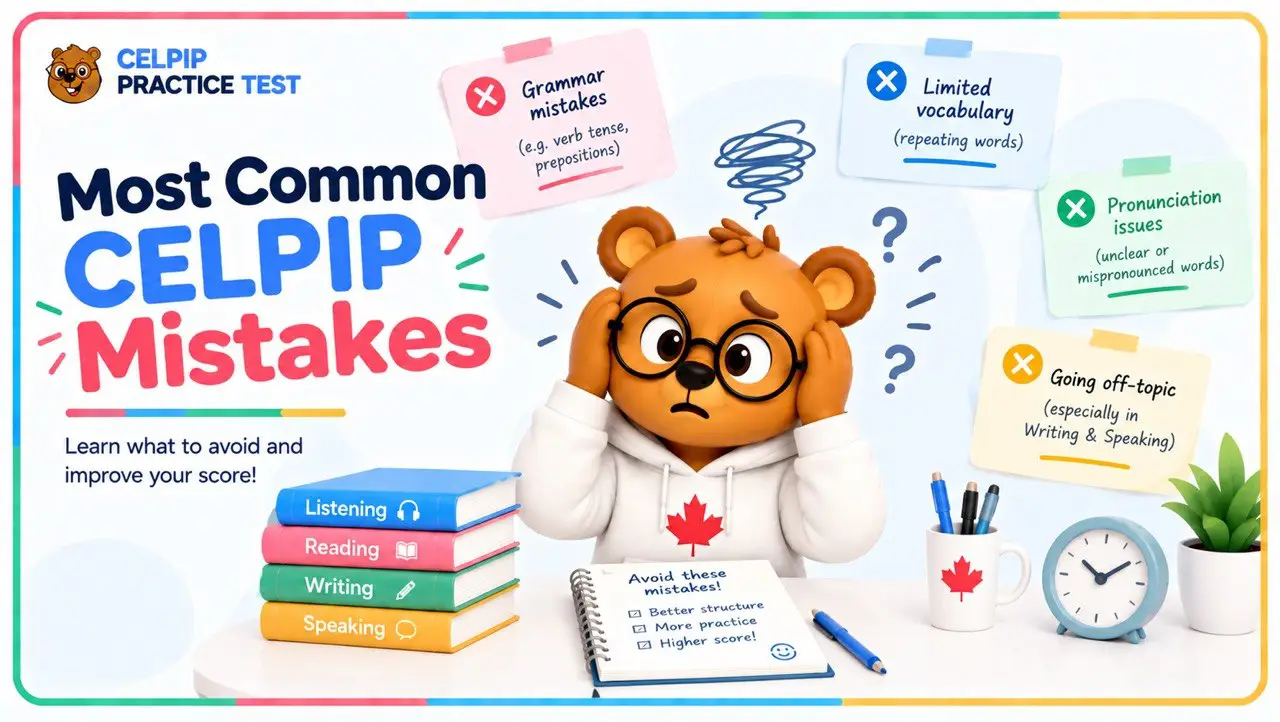
Preparation for the CELPIP test isn't about learning English. It's about learning how to make it function in your favor while being tested. Even well-prepared people tend to fall prey to the common mistakes of CELPIP test takers, not due to a lack of English proficiency, but due to a misunderstanding of how the test is designed and graded.
The CELPIP test is designed to test real-use language ability in timed conditions, so minor inaccuracies in focus, speed, or approach can result in unintended score loss and, the most common CELPIP mistakes will happen.
4 Common Mistakes in CELPIP Listening Section
The Listening section of the CELPIP test measures your capacity to understand spoken English. It is spoken in typical Canadian situations, from office conversation and customer calls to conversations with friends and news programs. You can check your listening proficiency via CELPIP listening practice test.
1- Not Listening for Keywords
The majority of candidates listen to what they anticipate, but don't listen for what is spoken. They don't anticipate that synonyms or paraphrases can be substituted for apparent words. The consequence is missing answers even when they were on the recording.
2- Writing Full Sentences instead of Key Phrases
Trying to write full sentences is a loss of time and mental energy. The Listening test tends to reward writing key words and main details.
3- Missing out on Collaboration Words & Discourse Markers
Yet, even though such words are listening signposts. If you don't hear them, you can misunderstand the relationship between ideas (cause/effect, contrast, sequence).
4- Depending too much on Memory rather than Notes
It's risky to say "I'll remember it". The recordings aren't replayed. They are often fast with a lot of details. Without notes, even good listeners forget small but vital facts.
CTA: Try the Listening Practice Test
3 Most Common CELPIP Mistakes in the Reading Section
Before we examine the most common CELPIP mistakes in the reading part, keep this in mind: good reading is not a matter of how quickly you can read; it's about accuracy, understanding, and making your time valuable. CELPIP practice test can help you boost your reading ability.
1- Skipping context or paragraph purpose
Sometimes people skip reading the introduction or topic sentence, jumping straight to questions. Without understanding why a passage or paragraph exists, you’ll misinterpret tone, inference, or the writer’s intention.
2- Choosing similarly worded distractors
In multiple choice, 2 options might look almost identical. Picking based on partial recognition rather than full understanding leads to wrong answers.
3- Not managing time per passage
Some are more compact or longer; others are simpler. Not doing time adaptively (removing tougher ones at the end, establishing mini-deadlines within the subsection) results in hurrying through or blanking on questions.
CTA Take a reading practice test
4 Common CELPIP Mistakes in the Writing Section
To succeed in the CELPIP writing section, you must balance your strong language skills and structure and purpose. And before we examine the most common CELPIP mistakes in the writing part, bear in mind: every sentence must build your message, not just filler space.
1- Off-topic replies / misreading prompt
Misreading the question, replying partially, or going off the point is the most gigantic failure. Not replying to all of the tasks, even with excellent grammar & vocabulary, cannot pull back those lost points.
2- Poor paragraphing and organization
The following table contains typical problems and solutions to them:
Problem | Impact on Score | Solution / Strategy |
Single long paragraph for the entire response | Hard to read; ideas are lost | Split text into introduction, body paragraphs, conclusion |
Coming together of a number of ideas under one paragraph | Reduces coherence; confuses reader | Restrict a single main idea per paragraph; use topic sentences |
No clear introduction or conclusion | Response doesn't feel complete; lower task completion | Start with brief introduction and end with summary/conclusion |
No coherence between sentences | Reader struggles to follow through | Employ words like firstly, however, therefore, in addition |
Paragraphs of different lengths | Disrupts readability | Balance paragraphs; typically 3–6 sentences in length |
3- Grammar and agreement errors
Most common CELPIP mistakes in the Writing section carry a lot of potential to affect your score adversely. Small errors add up. They are very frequent:
● subject-verb agreement
● improper tenses
● improper pronouns
● irregular number
● missing articles, etc.
Note that faulty pronouns mean incorrect usage of "he/she/they/it" or improper usage of possessive pronouns. In order to limit errors:
● proofread carefully
● emphasize prevalent grammar patterns
● perform specific exercises to strengthen proper usage
4- Using overcomplicated words incorrectly
Trying to impress with big words can backfire: using the words wrongly or in unnatural contexts hurts more than a simpler word used successfully.
CTA: Start the Writing Practice Test
6 Common Mistakes in CELPIP Speaking Section
The Speaking test of the CELPIP exam is meant to test your ability to use English correctly and comfortably in ordinary everyday situations. It not only tests vocabulary and grammar but also clarity, fluency, organization, and the capacity to respond to the stimulus. Check CELPIP speaking practice test for better understanding.
Most examinees consider this section difficult as it involves thinking and speaking simultaneously, frequently with no time for reflection. Success hinges on the ability to plan rapidly, deliver confident speaking, and organize ideas logically.
Those who prepare strategically, pay attention to pronunciation, and practice the actual testing conditions usually score higher.
Typical Speaking Error | Reason It Happens | Successful Solution |
Speaking too fast or too softly | test anxiety or ignorance of the sensitivity of microphones towards volume | Practice speaking with an even pace; record and listen to ensure clarity and volume |
Disregarding portions of the question | Racing through or misreading instructions | Divide the question prior to answering; jot down quick notes to address all sections |
Using excessive fillers ("um," "like," "you know") | Attempting to stall for time or fill silence | Substitute fillers with brief pauses or bridging words (so, therefore, because) |
Repetition of words or concepts | Limited range in vocabulary or nervousness | Practice paraphrasing with synonyms and examples during mock speaking tests |
Lack of coherence | Speaking without a start, middle, and end | Use a formula: Introduction → Reason → Example → Conclusion |
Monotone delivery | Grammar emphasis only, no tone | Use natural intonation and stress to sound confident and expressive |
CTA: Try the Speaking Practice Test
Learn from the most Common CELPIP Mistakes
Instead of just scribbling down your errors, ask yourself why they are happening. You can reduce them by following these rules.
· Recording Your Practice + Self-Review
Record your answers as you talk and review your writing tasks after every practice session. You will discover that pacing, pronunciation, and clarity problems are not evident when you hear yourself talk.
Similarly, reading your writing after a pause for some time will make you realize grammar, structure, and coherence problems. With time, this becomes second nature. Automatically, you will identify and correct weaknesses.
· Peer Review / Tutor Feedback
You're often too near to your writing to catch mistakes. That's where peer or tutor feedback is useful. A study buddy or tutor can notify you of:
● Repeated grammar issues
● jumbled sentences
● logical errors you may not notice.
Periodic sessions of feedback also keep your sense of accountability intact and provide tips on how your answers stack up with respect to CELPIP score criteria.
· Mock Test Reflection & Error Log
After every one of the mock tests, spend time looking at your scores and not dashing towards the next. With every one of your revisions, patterns will reduce as you are using improved methods consciously. Slowly, you will find patterns disappear as you consciously correct them.
Tips to Avoid Most Common CELPIP Mistakes
Every question has special requirements, whether word limits on written exercises or what to look for in listening or reading questions. A missed instruction can mean losing valuable marks. Tips to reduce exam-day errors:
● Read instructions carefully
● Note task requirements, word count, and information
● Relax and go past challenging items
● maintain momentum and reduce stress
● Time buffer and pacing
● manage time effectively
● leaving room for review
Mistakes to Milestones: How You Can Attain CELPIP Success
We have gathered common CELPIP mistakes in this article. Remember, CELPIP mastery is not perfection. It is preparation, sensitivity, and smart learning. Although there are various types of mistakes available in CELPIP different sections, you can avoid them by practising carefully and using the practice tests available at https://celpippracticetest.com/.